When the Song Plays and Your Skin Remembers: The Strange Intimacy of a Music Tattoo
There's a moment — you probably know the one — where a song stops being something you listen to and starts being something that lives inside you. For a lot of people, that moment ends with a tattoo appointment. The lyric, the album art, the chord shape, the waveform. Something gets pulled out of the speakers and pressed permanently into skin.
But here's the thing nobody really talks about: once that ink heals, the song changes. Not the recording — that stays exactly the same. But the way you receive it? That shifts in ways that are hard to articulate and even harder to undo.
It's Not Just Sentiment. It's Sensory.
Ask anyone who has a song-specific tattoo what happens when that track comes on shuffle, and you'll get answers that sound almost neurological. People describe a kind of full-body awareness — a pull toward the tattooed area, a heightened attention, something that functions less like memory and more like reflex.
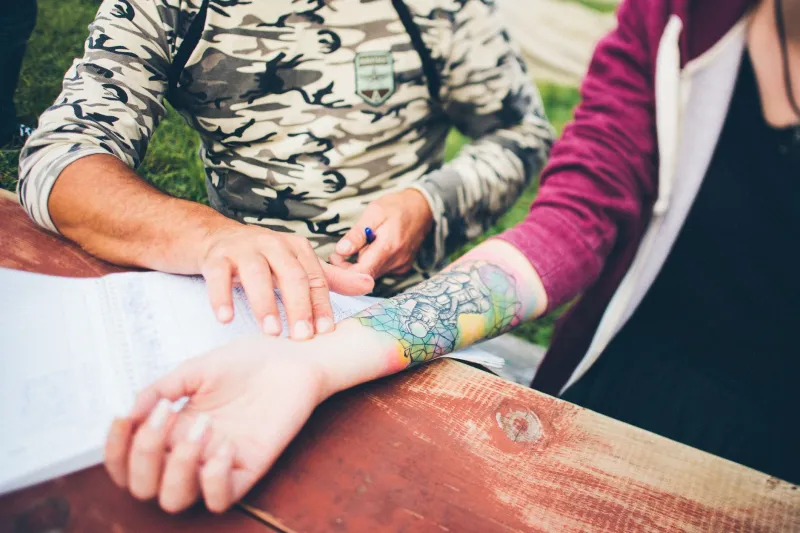
Jamie, a 34-year-old from Austin who has a line from a Phoebe Bridgers song tattooed along her forearm, puts it plainly: "I touch it without thinking. Every single time the song plays. It's like my arm is part of the listening experience now."
That's not a small thing. Most of us engage with music through ears, maybe through movement. Adding a tactile anchor — a physical location on your body that's tied to a specific piece of music — creates a feedback loop that psychologists who study embodied cognition would find genuinely interesting. The song isn't just heard. It's felt, in a very literal sense, at a specific point on your body.
The Live Show Problem (And Why It's Actually Beautiful)
Here's where it gets complicated. Hearing your song through headphones on a Tuesday morning is one thing. Hearing it live — in a crowd, with the bass rattling your chest, with the artist three hundred feet away — is something else entirely.
Fans with music tattoos consistently describe a kind of performance anxiety around live moments. Not stage fright, exactly, but a heightened emotional stakes that can feel almost overwhelming. You've made a permanent commitment to this music. And now the music is happening in real time, and it has to measure up. Except you also have to measure up to it.
Marcus, 29, from Chicago, got a tattoo of the opening guitar tab from a Wilco song after seeing them play at Lollapalooza years ago. He's seen them play it live four more times since. "The first time after getting the tattoo, I genuinely teared up before they even finished the first verse. But it wasn't clean — it was messy. Like, I suddenly felt responsible for this thing I'd made permanent. What if I didn't feel it the same way? What if the song didn't hit?"
That anxiety — the fear that the tattoo has somehow raised the emotional bar too high — is something that comes up again and again in conversations with inked music fans. There's a vulnerability to it. You've declared something forever, and now every live performance is a kind of test.
How the Relationship Evolves Over Years
The really fascinating territory is the long game. What happens to a song tattoo five, ten, fifteen years down the road?
For some people, the tattoo becomes a kind of emotional time capsule. The ink preserves the version of themselves that got it — the 22-year-old at their first real festival, the person going through a breakup who needed that lyric to survive the week. Hearing the song later becomes an act of visiting that past self, and the tattoo is the address.
For others, the relationship gets more complicated. People grow. Musical tastes evolve. Sometimes the song that felt like the most important piece of art in the world at 24 lands differently at 38. But the tattoo doesn't care. It just sits there, unchanged, asking you to reckon with who you were when you made that call.
There's a woman named Delia, 41, from Portland, who has a tattoo from a song she describes as being from a "chapter of my life I've mostly moved past." She doesn't regret it, exactly. But she says hearing the song now is like running into an old version of herself at a grocery store. "It's not bad. It's just a lot. The tattoo makes the song feel like unfinished business, even when it isn't."
The Flip Side: Songs That Grow Into Their Ink
Not every story goes the complicated route. Plenty of fans describe the opposite effect — where the tattoo seems to deepen the song over time rather than complicate it.
This tends to happen when the song itself is tied to something ongoing rather than something fixed. A tattoo honoring a song that's about resilience, or change, or love in the abstract — rather than a specific person or moment — seems to have more room to grow with the listener. The ink becomes less a monument and more a living document.
Reed, 36, from Nashville, got a lyric from a Jason Isbell song tattooed after a period of serious personal struggle. He's now several years out from that period, in a much better place, and he says the tattoo has transformed from a lifeline into something more like a trophy. "I hear that song now and I feel like I earned it. The tattoo reminds me what it cost. That's not a bad thing at all."
What This Means for How We Think About Music and Identity
At its core, the song tattoo phenomenon is about the relationship between identity and art — and how we use art to mark the boundaries of who we are at specific moments in time. Music is already deeply tied to memory and selfhood. Tattoos are already a language for expressing who we are and where we've been. When you combine them, you get something that's more than the sum of its parts.
You get a song that talks back.
You get a piece of music that has a physical address on your body, that registers in your nervous system differently than anything else in your playlist, that carries the weight of a decision you made and a moment you lived.
The next time you're at a festival and that song comes on — the one with the tattoo — notice what happens. Notice where your hand goes, notice the shift in your chest, notice whether you feel pride or grief or something that doesn't have a clean name yet.
That feeling? That's the setlist effect. And once it's in your skin, it never fully leaves.