One Arm, Every Era: How Serious Collectors Build Sleeves That Survive Their Own Evolving Taste
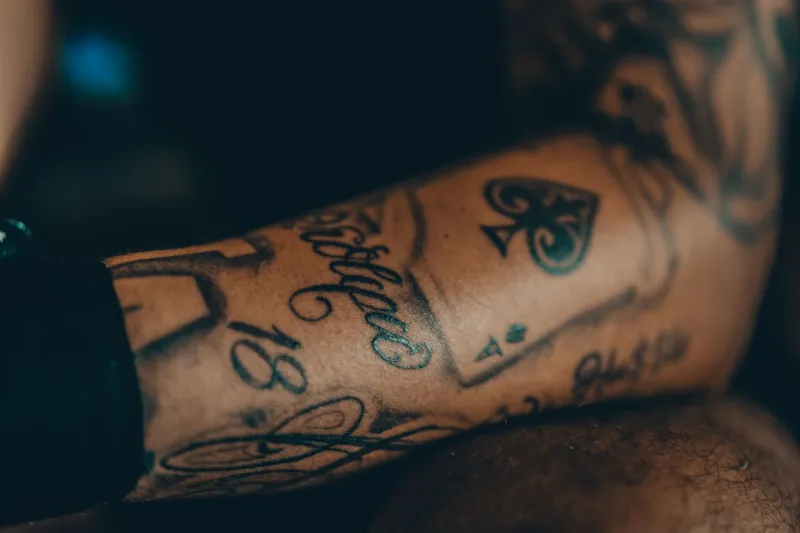
Let's be honest about something. The person who got that Pantera flash piece at 19 is not the same person who spent last summer crying to Phoebe Bridgers in a tent at Bonnaroo. And that's fine. That's actually the whole point of being a music fan — you grow, you shift, you find new sounds that crack you open in ways you weren't expecting. The problem is your arm doesn't reset. Every tattoo you've ever committed to is still right there, and now you've got a half-finished sleeve that looks less like a cohesive vision and more like a greatest hits album with no through-line.
This is the collector's dilemma, and it's way more common than people admit.
The Myth of the Perfectly Planned Sleeve
Ask any experienced tattoo artist and they'll tell you the same thing: almost nobody walks in with a fully realized sleeve concept and executes it start to finish without changing their mind at least once. Life gets in the way. Tastes shift. A breakup sends you deep into soul music. A new friend group pulls you toward hardcore. A road trip through the Southwest somehow turns you into a person who cares deeply about alt-country.
Jazmine Torres, a tattoo artist based out of Austin who's built a reputation for helping clients wrangle complex, music-heavy sleeves, puts it plainly. "People come to me with this guilt, like they've done something wrong because their sleeve doesn't have a clean concept anymore. But honestly? The messiness is often what makes it interesting. The job is figuring out how to honor all of it."
The key word there is honor. Not erase. Not pretend the metal years didn't happen. Not cover everything up with a massive background fill and start over. The goal, for most serious collectors, is integration — finding the visual and conceptual thread that ties seemingly incompatible influences into something that reads as intentional.
Design Strategies That Actually Work
So how do you get a Slayer skull, a Tribe Called Quest vinyl reference, and a delicate line-work portrait of Elliott Smith to coexist on the same forearm without looking like a fever dream? Turns out there are real strategies, and artists who specialize in this kind of work have developed some genuinely clever approaches.
Unified background elements. One of the most reliable tools is building a cohesive background that ties disparate foreground pieces together. Think deep black-and-grey shading that bleeds across the whole arm, or a consistent botanical element — thorns, vines, dead flowers — that weaves between existing tattoos regardless of their style. The foreground pieces can be wildly different in subject matter, but if they're all sitting inside the same atmospheric world, the eye reads them as part of a family.
Color palette discipline. This one's harder to pull off if you've already got some color work on the arm, but for collectors still in the building phase, committing to a limited palette early can be transformative. A sleeve that mixes death metal imagery, hip-hop iconography, and indie folk references can still feel unified if everything lives in the same tonal range — say, muted earth tones with selective black accents, or a full black-and-grey approach that treats every subject with the same visual weight.
Thematic abstraction over literal representation. Instead of tattooing a band's logo or album cover directly, some artists work with collectors to pull out the feeling of a particular musical era and translate it into imagery that's more abstract. Your hardcore phase becomes a set of geometric shapes with aggressive negative space. Your shoegaze obsession becomes blurred, overlapping textures that seem to vibrate. The music is in there — you know it's in there — but it's expressed through mood rather than merch.
Real Collectors, Real Arms
Marcus, a 34-year-old from Chicago, started his left sleeve at 21 with a full traditional-style portrait of a Wu-Tang logo. Over the next decade, he added a Neurosis-inspired abstract piece, some blackwork geometric work he got at a festival in Tennessee, and a delicate fine-line piece of a cassette tape he associates with a specific Sufjan Stevens album. On paper, that sounds like a disaster. In practice, his artist spent two sessions building out a dark, textured background that pulls everything into a single visual field. "People always ask if it was planned," Marcus says. "It wasn't. But it looks like it was, and that's kind of the magic."
Then there's Deja, a 28-year-old from Atlanta who took a completely different approach. She leaned into the chaos intentionally, working with her artist to frame the sleeve as a literal timeline — oldest pieces near the shoulder, newest near the wrist, with transitional filler work between each era that suggests movement and progression. Her arm is basically a biography. "I stopped trying to make it look like one thing," she says. "Now it looks like me, which is better."
When to Call It and When to Keep Building
One of the harder conversations in sleeve building is knowing when to stop adding and start refining. Torres says she sees a lot of collectors who keep piling on new pieces hoping the next one will magically tie everything together, when what they actually need is to step back and do some connective work first.
"Sometimes the answer isn't another tattoo," she says. "Sometimes it's spending a session on background fill, or touching up something old so it reads at the same level as the newer work. People want to add, add, add. But editing is a skill too."
This is especially true for music fans whose tastes are still actively shifting — which, let's be real, is most of us. If you're 25 and already three-quarters through a sleeve, it might be worth leaving some real estate open for whoever you're going to be at 35. Future you might have opinions.
The Sleeve as Living Document
Maybe the most freeing reframe for collectors wrestling with this is to stop thinking of the sleeve as a finished product and start thinking of it as a living document. Your musical taste is an archive of who you've been and a preview of who you're becoming. A sleeve that reflects that honestly — that shows the metal years and the R&B years and the weird ambient phase you went through during lockdown — is more interesting than a perfectly coordinated concept that only captures one version of you.
The best sleeves aren't the ones that look like they came from a single session with a single artist executing a single vision. They're the ones that look like a life. Messy, layered, occasionally contradictory, and entirely yours.
That's the whole thing, really. Ink is just another way of saying this mattered to me. And if enough different sounds have mattered to you over the years, your arm gets to say all of it.