Your Playlist, Your Pain: How the Right Music Can Change Everything in the Tattoo Chair
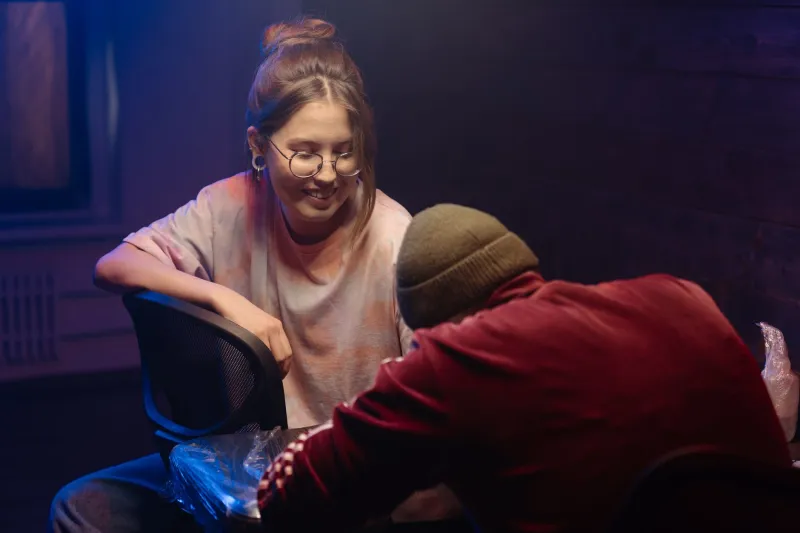
Ask anyone who's spent serious time in the tattoo chair and they'll probably tell you the same thing: the music matters. Not in a vague, background-noise kind of way — in a this song carried me through three hours of shading on my ribs kind of way. There's a reason tattoo artists are weirdly particular about what plays in their shops. The soundtrack isn't incidental. It's part of the work.
And science, it turns out, has some things to say about that.
The Needle and the Note
Pain is never just physical. It's filtered through your nervous system, your emotional state, your attention, your memories. Music hacks all of that simultaneously. Research in music psychology has shown pretty consistently that listening to music you enjoy reduces the perceived intensity of pain — not by numbing anything, but by redirecting cognitive resources. Your brain gets busy processing rhythm, melody, and lyrical meaning, and has fewer bandwidth left to amplify the discomfort signals coming from your skin.
For tattoo clients, that's not a small thing. A four-hour session on a bony spot — shin, spine, sternum — is a genuine endurance test. The difference between white-knuckling it in silence and floating through it on the back of a perfectly chosen album can be enormous. Artists who've been doing this for years know it intuitively, even if they've never read a single study.
"I've watched people's entire body language change when a song they love comes on," says Maya, a tattoo artist based out of a shop in East Nashville who's been tattooing for over a decade. "Their shoulders drop. Their breathing slows. I can actually work better when a client relaxes like that — the skin responds differently when someone isn't tensed up."
She's not exaggerating about the skin part. Tension causes muscles to tighten and the surface to become less forgiving under the needle. A client who's genuinely at ease — helped along by a playlist that feels like it was made for them — is easier to work on and usually heals better too.
The Artists Who Treat the Queue Like a Craft
Not every shop plays music the same way. Some artists run a single personal playlist on shuffle, using it more for their own focus than their client's comfort. Others approach curation as a genuine extension of the service they're providing.
Darius, who runs a private studio in Portland, Oregon, sends a short questionnaire to new clients before their appointment. Among the questions: three artists or albums that feel meaningful to them right now. He builds a session playlist around those answers, blending the client's taste with pieces he knows from experience help regulate energy in the room.
"I think of the playlist like the lighting or the temperature," he says. "It's part of the environment I'm creating. If someone comes in anxious, I'm not going to open with something abrasive and fast. I'll start somewhere grounding and let it build."
He's noticed patterns over the years. Slower tempos tend to help during linework that requires precision and stillness. Something with more energy — not aggressive, just present — can actually be useful during long shading passes where the client needs something to hold onto mentally. "It's almost like pacing someone through a workout," he says. "The music does some of the coaching."
Over in Chicago, Renee takes a different approach. Her shop has a standing rule: the client picks the playlist, no exceptions. "This is their body and their experience. I'm not going to impose my taste on that. If someone wants to listen to two hours of mid-2000s pop-punk while I tattoo them, then that's what we're doing, and honestly? Those sessions are usually incredible. People get emotional in the best way."
Memory, Music, and Why the Two Get Tattooed Together
Here's where things get genuinely fascinating. The same neurological mechanisms that make music reduce pain also make it an unusually powerful memory anchor. The hippocampus — the brain's memory hub — has deep connections to the auditory cortex and the limbic system, which handles emotional processing. Music heard during an emotionally significant or physically intense experience tends to get encoded with unusual clarity and permanence.
In other words: whatever's playing while you get tattooed is probably going to be fused to that tattoo for the rest of your life.
Clients report this constantly. A woman in Austin described getting a large floral piece on her thigh while her artist played a specific Phoebe Bridgers album start to finish. "I can't listen to that record now without feeling like I'm back in that chair — not in a bad way, more like a full-body memory. The tattoo and the music are the same thing to me at this point."
A guy in Brooklyn talked about getting his first large piece — a traditional eagle across his chest — while his artist played a playlist of old Springsteen deep cuts. "I grew up with that music. My dad played it constantly. Getting tattooed to it felt like something was being sealed in, you know? Like I was making it part of my body in a real way."
That's not a coincidence or a quirk. That's the brain doing exactly what it's built to do: binding sensory experiences together into something cohesive and lasting.
What Happens When the Song Is Wrong
The flip side is real too. Music that clashes with a client's mood or taste can actively make a session harder. Anxiety goes up. Time feels slower. Pain becomes more central to the experience rather than something the mind can work around.
"I had a guest artist in once who played really harsh, abrasive metal the whole session," recalls Maya. "My client was getting something delicate and personal — a memorial piece for her mom. She pushed through it but told me afterward that the music made it feel cold. It bothered her more than she let on at the time."
The lesson most artists take from experiences like that: check in. Ask. Don't assume your taste is neutral or universal. The chair is an intimate space, and the sound filling it is part of what makes the experience feel safe — or doesn't.
The Setlist You'll Never Forget
There's something poetic about the overlap between tattoo culture and music culture that goes way beyond aesthetic. Both are about making things permanent. Both are about choosing what you carry. The festival connection is obvious — anyone who's gotten tattooed at a music event knows that the sound bleeding through the tent walls becomes part of the memory as surely as the ink does.
But even in a quiet studio on a Tuesday afternoon, the music plays a role. The right song at the right moment can shift the entire emotional register of a session. It can make someone feel held when they're nervous, connected when they're grieving, euphoric when they're celebrating.
Your tattoo artist is working on your skin. The music is working on everything else.
And when it all lines up — the design, the artist, the song — what you walk out with isn't just a tattoo. It's a whole experience compressed into something you'll wear for the rest of your life. That's worth being intentional about.