Sorry, Not Sorry: Why Some Tattoo Artists Won’t Ink Your Favorite Band’s Logo
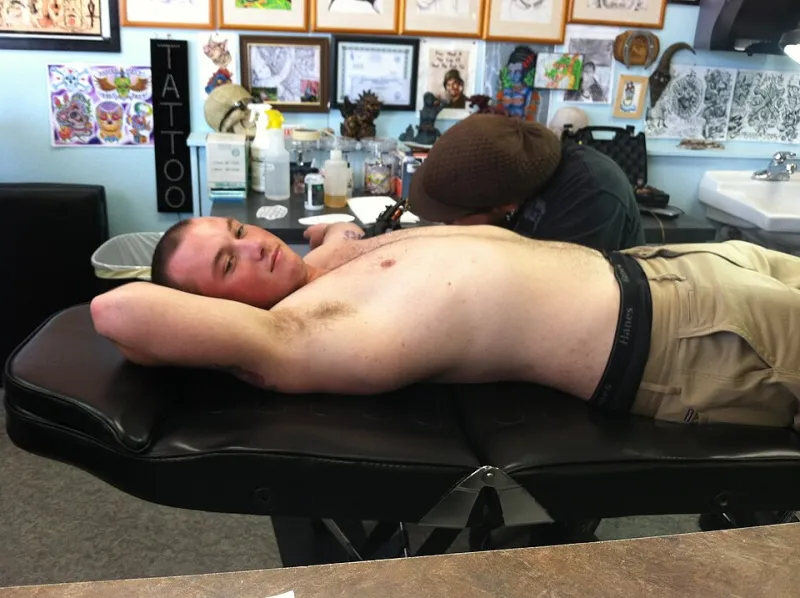
Photo: Tony Alter from Newport News, USA, CC BY 2.0, via Wikimedia Commons
The request is almost always sincere. A fan sits down, pulls up a screenshot of a band logo, and says some version of: this album got me through the worst year of my life. Can you put it right here?
And sometimes the artist says no.
Not because they hate the band. Not because they’re judging the fandom. Because the logo is a trademark, because the reference is terrible, because the design is overdone, because the band’s history has curdled, or because the artist has learned that some requests are better served by a conversation than a needle.
“I’ve had people get genuinely angry with me,” says Jules Park, who owns a tattoo shop in Portland. “They hear no and think I’m rejecting their identity. I’m not. I’m rejecting a specific drawing on a specific body part at a specific moment.”
Welcome to the messy little borderland where fandom meets craft. In 2026, band logos are everywhere—on shirts, on TikTok, on the rail at festivals, and on the arms of people who want to carry the music permanently. Artists are not copy machines. And the ones who say no are often trying to protect the tattoo, the client, and the shop.
The request that makes artists sigh
Band logos are popular because they work. They’re immediate. They say I was there, I belong, I love this. But that immediacy is exactly why some artists hesitate. A logo is a piece of graphic design made for merch, album covers, and stage backdrops. It is not automatically a good tattoo. It may have thin lines, tiny text, negative space that will blur, or a shape that fights the curve of an arm.
“A lot of logos are designed to look good on a screen or a T-shirt,” says Nia Brooks, a tattoo artist in Atlanta. “On skin, they can turn into a muddy little stamp. I’d rather rework the idea than tattoo something that’s going to look like a bruise in two years.”
Copyright is not a vibe
Here’s the uncomfortable part: band logos are often protected by trademark and copyright. Tattoo artists are not lawyers, and practices vary. Some artists will tattoo a logo as fan art without much thought. Others refuse because they don’t want to reproduce a protected design, especially when the request is essentially a direct copy. This isn’t legal advice. It’s shop-floor reality.
“I’m not trying to be the trademark police,” Park says. “But I also don’t want to be the person who copied a logo line for line and put my name on it. There’s a difference between being inspired by a band and running a Xerox machine.”
When the logo is just... done
Then there’s the fatigue factor. Some logos are so common that artists have tattooed them hundreds of times. The result can be technically fine and creatively flat. A good artist wants to make something that feels like yours, not like the fifteenth version of the same sticker.
“I’ve done a lot of band tattoos that I love,” Brooks says. “But when someone brings me a blurry logo and says ‘just like this,’ I know we’re not making a great tattoo. We’re making a copy of a copy.”
Bad references, bad tattoos
A shocking number of requests arrive as screenshots of screenshots. The logo is pixelated. The text is unreadable. The colors are washed out. The fan says, “You can just clean it up,” which is a nice way of asking the artist to invent the whole design while pretending they didn’t.
Artists who decline poor references are not being precious. They’re being honest about what skin can hold. If the source material is bad, the tattoo will be a negotiation with blur. A good artist might ask for a high-resolution image, a vinyl cover, a tour poster, or a better angle. If the fan can’t provide it, the artist may suggest a different approach.
The ethics clause
Some refusals are about the band itself. Maybe the artist has personal reasons. Maybe the band has a history of abuse allegations, hateful messaging, or behavior the artist doesn’t want to permanently associate with their work. Fans sometimes argue that the tattoo is about the music, not the musician. Artists sometimes argue that ink is a collaboration, and they get to decide what they put their name on.
That’s not cancel culture. That’s a person with a needle making a choice about their labor. You can love a record and still understand why someone else won’t draw its logo on your skin.
What artists offer instead
The best refusals come with options. A custom riff on the logo. A lyric in the band’s typography. A symbol from the album art. A reimagined crest that keeps the spirit but changes the shape. A black-and-gray interpretation. A smaller, simpler mark that ages better.
“I’ll say, ‘I’m not going to copy this, but here’s what I can do,’” Brooks says. “Most people calm down when they realize I’m not saying no to the band. I’m saying no to a bad plan.”
The business of saying no
Saying no costs money in the short term. A declined appointment is an empty chair. But artists who say no well build trust. They get clients who come back for custom work. They avoid cover-ups they’d rather not be associated with. They protect their reputation in a industry where screenshots travel fast.
The fans who storm out sometimes come back. The ones who don’t were probably going to be a difficult client anyway. And the ones who listen often end up with a better tattoo—one that still says I love this band, but also says I thought about it.
The bottom line
A band logo is not a personality test, and an artist’s no is not a rejection of your fandom. It’s a boundary. Sometimes it’s about copyright. Sometimes it’s about craft. Sometimes it’s about ethics. Sometimes it’s about the fact that the reference photo looks like it was taken through a greasy window.
If you want the logo, ask. If the artist says no, ask why. Then ask what they’d do instead. The best tattoo might be the one that starts with a conversation instead of a copy-paste.