One Night, Twenty Songs, Forever on Your Skin: The Rise of the Setlist Tattoo
There's a particular kind of concert experience that doesn't just stay with you — it restructures you. The lights go down, the first chord lands, and something inside you quietly rearranges itself. You're not the same person walking out that you were walking in. Most people carry that feeling in memory. A growing number of them are carrying it in ink.
The setlist tattoo is exactly what it sounds like: a permanent record of the exact songs played at a specific show, in the exact order they were performed, etched into skin as a kind of living archive. Not a band logo. Not a lyric floating in isolation. The whole journey — song one through the encore — preserved like a setlist that can never get rained on, thrown away, or lost in a move.
And the people getting them will tell you, without hesitation, that there's a massive difference.
More Than Merch, More Than a Logo
Traditional band tattoos are acts of allegiance. They say I belong to this music, and this music belongs to me. A setlist tattoo says something narrower and, in a weird way, more profound: I was there. That specific night. And it mattered more than I have words for.
Sarah Delacroix, a 29-year-old from Nashville, got her setlist tattoo after seeing Phoebe Bridgers at the Ryman Auditorium in 2022. "I've loved her for years," she says. "But that night was different. She played 'Savior Complex' third, and I just — I started crying before she even finished the first verse. The whole set felt like it was built for me personally. I needed to keep it somewhere I couldn't lose it."
The tattoo runs down her left forearm: each song title in clean, hand-lettered script, separated by small dashes, with the venue and date anchoring the bottom like a caption. It looks less like a tattoo and more like a artifact.
That's kind of the point.
What Tattoo Artists Are Actually Dealing With
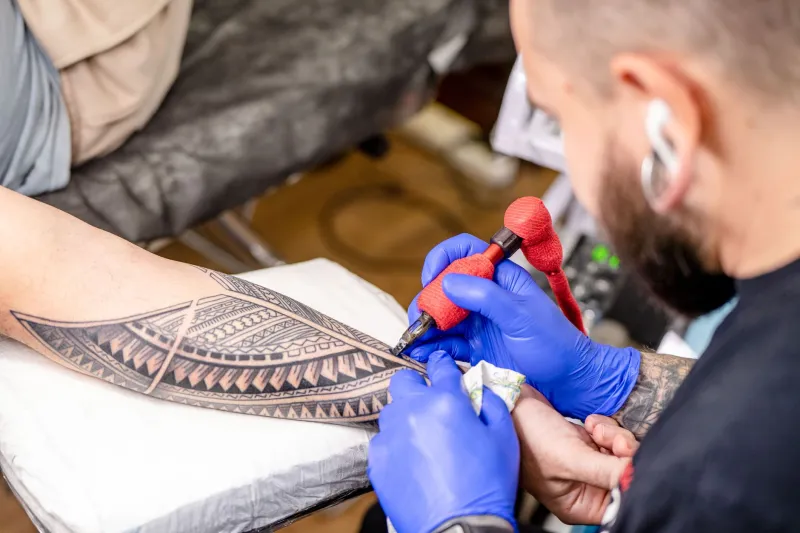
From a technical standpoint, setlist tattoos present a genuinely interesting challenge. You're working with a lot of text — sometimes fifteen to twenty-five song titles — and the design has to stay legible for decades while also feeling intentional rather than just functional.
Marcus Webb, a tattoo artist based out of Chicago's Wicker Park neighborhood, says he's done at least a dozen setlist pieces in the past two years alone. "The biggest thing people don't think about is longevity," he explains. "Fine-line lettering is beautiful right now, but thin lines can spread and blur over time. I have to have a real conversation with clients about font size, spacing, and placement so this thing still reads clearly in twenty years."
Placement matters enormously. Forearms and ribcages are popular, but Webb notes that skin texture and movement affect how text ages. "A ribcage piece on someone who works out a lot is going to behave differently than the same piece on someone with a more stable skin surface. We're thinking about the whole lifetime of the tattoo, not just how it looks on day one."
Other artists are pushing the concept further — incorporating actual setlist aesthetics into the design, mimicking the handwritten scrawl of a stage-used setlist, complete with tape marks and coffee-ring stains rendered in ink. Some clients bring photographs of the physical setlist from the stage to use as direct reference. The result is something closer to trompe-l'œil than traditional tattoo work, a hyper-specific document disguised as body art.
Why This Night and Not Another
The psychology behind the setlist tattoo is worth sitting with for a second. Music fans see dozens, sometimes hundreds, of shows over a lifetime. So what makes one night the one?
It's rarely about technical perfection. More often, it's about convergence — the right song at the right moment in someone's life, amplified by the communal electricity of a live crowd. A breakup that was still raw. A grief that hadn't found its shape yet. A joy so full it had nowhere to go. The concert becomes a container for all of it, and the setlist becomes the map of that emotional terrain.
Jordan Okafor, 34, got his setlist tattoo after a Bon Iver show in Minneapolis the year his father passed away. "Justin Vernon played 'Holocene' right before the encore," he says. "I had been holding it together all night and that song just broke me open completely. I looked around and everyone in that room was somewhere deep inside themselves. It was the most connected I'd felt to other people in months."
His tattoo includes the full setlist from that night, but 'Holocene' is rendered slightly larger than the rest — a visual weight that communicates what words can't quite manage.
The Difference Between Memory and Monument
Here's the thing that separates a setlist tattoo from other concert memorabilia: it doesn't just remind you of the experience, it anchors it. Concert tickets fade. Photos flatten. Memories drift and distort. But a tattoo is a daily, physical fact.
Every time you glance down at your arm and see that list of songs, you're not just remembering — you're re-inhabiting. The body becomes a kind of time machine, pulling you back to that specific room, that specific crowd, that specific version of yourself standing in the dark while the music did whatever it did to you.
Tattoo artists describe clients getting emotional during the sessions themselves, the act of receiving the tattoo becoming its own ritual continuation of the original experience. Some people listen to the show's setlist on headphones while they're being tattooed. Some bring friends who were there. Some come alone and sit quietly, the needle sound mixing with whatever they're replaying in their head.
Not for Everyone, Exactly Right for Some
It's worth being honest: a setlist tattoo is a commitment that requires a very specific kind of certainty. Unlike a band logo, which can theoretically represent an evolving relationship with an artist's whole catalog, a setlist tattoo is locked to a moment. If you fall out of love with the music, the monument remains.
Most people who have them say that's precisely the appeal. The tattoo doesn't represent who they are now — it represents who they were then, in that room, when something cracked open. It's less a declaration of current identity and more a permanent thank-you note to a night that earned it.
And honestly? That's a pretty beautiful reason to sit in the chair.
The setlist tattoo is, at its core, a love letter to the specific. Not to music in the abstract, not to an artist's entire discography, but to twenty songs on a Tuesday night in a venue that smelled like spilled beer and possibility. It's proof that you were there, that it mattered, and that some nights deserve more than a fading memory.
Some nights deserve to be written on your skin.